Book review of "The Beautiful Risk of Education"

One of the things I have said I will do over the last two years is write a blog - don't know why I decided to do that. I think it was one of those things "that sounded good in my head"....anyway the other thing I did was tell Faye and of course the pressure has now been applied (ever so nicely!!!!) to put  my words into action. 

So here is the first Learning Network NZ resources orientated blog hopefully the first of many ( but not too many!!).

Some  of the things you will need to know about this blog is that I am NOT AN EDUCATOR - even though I have worked at LNNZ for 10 years this year I do not have an educational background other than my own schooling - which is too many years away to remember!! 

You will also need to know that the books I focus on are just books that some people (maybe even me!!!!) have liked/used/bought/found useful/commented on - they are not endorsed or recommended by LNNZ or even the people that have shared them with us. They are just interesting books.


So the first book is "The Beautiful Risk of Education" by Gert J J Biesta. It was originally bought to my attention by a University Lecturer who was wanting to get her hands on a copy and we were able to source and supply for her, and "it had me at Hello" the first sentence of the description says "....education is not about filling a bucket but about lighting a fire" 


Here are some book reviews  in particular one from NZ's own  He Kupu with a book review by Chris Naughton from 2013  HERE.


We also this interview with the author on why he wrote the book and what the aim was, from the Philosophy of Education Society of  Great Britain  HERE 

The author has a new book out later in the year "The Rediscovery of Teaching" so maybe we will review that as well


Professor Guy Claxton'sVisit to New Zealand


Last week Learning Network NZ had the pleasure of bringing Professor Guy Claxton back to NZ in order to enable you as teachers the chance to review how you can effectively "raise achievement & build character" within your busy classroom environment.

By all accounts it was  a successful tour, apart from poor Guy having a ghastly flu.  Each venue was at full capacity, all the attendee's that I had the pleasure of coming  into contact with, really enjoyed the intensity of the day and felt inspired to be there.  

The content  Guy shared and projected was both powerful and practical, enabling the attendee's to take away some know how and keep sake strategies to apply within the busy classroom/school environment.  

Essentially Guy enabled school practitioners to gain more confidence and know how on how to apply "Building Learning Power" more successfully within their individual environment!

BUILDING LEARNING POWERED CLASSROOM 

As Guy suggests, this can be gained by implementing gradual, cumulative adjustments within the class around some of the following key shifts:
The language used within the classroom, 
Timetable adjustments
Self-review
Implementing "a coaching culture"
Investing in teaching methods
                                              Cumulatively gaining long term results!

SUGGESTED RESOURCES TO AIDE IN YOUR BLP TEACHING & LEARNING: 

1)   The Learning Powered School – Pioneering 21st Century Education, by Guy Claxton & Bill Lucus 
2)   Educating Ruby - What our Children really need to learn, By Guy Claxton & Bill Lucus 
3)   How Children Succeed  - Grit, Curiosity & the Hidden Power of Character, by Paul Tough 
4)   Challenging Learning - James Nottingham (*the learning Pit that Guy referred to) -also visiting NZ "one day only" 24 June.


Due to POPULAR DEMAND 

Professor Guy Claxton revisits

 AUCKLAND, QUEENSTOWN & NELSON

 in just over THREE WEEKS ..have YOU got your Ticket?


DONT MISS OUT!!! Book now to avoid disappointment!


Breakfast Webinar Series 2016

Fast approaching Webinar Series for 2016.  Get your coffee & virtually plug in to gain practical tips and ideas for shifting your pedagogy to increase learners level of engagement, progress and agency.  This is a great chance to collaborate first thing in the morning, throughout the year.

Building Learning Capacity with Tony Ryan at Waipuna 29 January 

Thanks to all of those that attended Friday’s uplifting, mind provoking conference at Waipuna hosted by the awesome Tony Ryan.  Being a newbie to the Learning Network NZ team, this was my first event to participate in and what a pleasure it was.  Not only hearing Tony talk with such passion but seeing everyone in attendance engaged and inspired.  

Listening to Tony, commanded engagement and interactivity amongst your peers, whereby I could see all those attending becoming more and more inspired and animated as the day transpired. 

Tony raised questions to shift our thinking.  How can we embrace technology and identify “what is worthwhile”?  What technology can assist with minimising the impact on our time and maximise a holistic shift within the school environment whereby you as a teacher can successfully embrace pedagogy (*child based learning) and andragogy (*adult based learning) continuously, resulting in injecting enthusiasm, participation and the art of GREAT learning within your school. 

Tony reviewed ways in which you can audit current demands being placed on you,  resulting in creating more learning time by simply de-cluttering and simplifying what you need to do from what you could do “if only you had more time”?

The energy within the breaks stimulated me to review what influenced some Principals to bring their entire team to this teacher’s only day and if any of their prior perceptions of what to expect were met/exceeded?

This is some of the feedback collated about this day from new teachers embarking on their teacher journey, through to experienced teachers and some Principals.  Inspired learning springs to mind!


Key insights/reminders gained from a new teachers point of view embarking on a new career included:-

Came along to the day with no expectations and was blown away with how helpful attending the teacher’s only day was due to:-
·    Gaining tools to assist her with not getting overwhelmed when in the classroom environment
  •          Gaining useful mapping tools to enable prioritising
  •          Reiteration of why you became a teacher in the first place
  •          Inspiring creativity to the way in which you approach your classroom

Principals  perspectives included:
Bringing the entire teaching team along to the teacher’s only day was a twofold gain.  
One because it is a GREAT approach to a new year, collectively the teaching team can bond by starting the New Year inspired and become focussed for the year ahead on their role as connected, confidant continuous lifelong learners also.

“As life gets busy it becomes easy in teacher mode to forget about YOUR role as a learner!”
As recommended by Tony, we can now take your orders.
“Tony engages teachers as adult learners”

The second year running they have brought their entire teaching team to kick start the new teaching year with mindfulness around focusing on you as a teacher’s adult learning as much as the children in your class learning and looking after each other as a team.

Other teacher’s feedback/out takes:

“Awesome way to start a year, gained above and beyond what was expected by Tony’s inspiration and teachings.  Gives staff the opportunity to re-invent how they approach their environment and spark innovation within the classroom.  Huge plus to attending is gaining some gratefulness tools to share with the kids.”
“We came last year and are still talking about and quoting outtakes.” 
“Expectation of high quality course has not been disappointing”.  I have had an excited buzz all day.
"We have gained inspiration for the year and had a great time as a team bonding!"
"Tony made you think & question beyond what you are doing and celebrating that everyone is doing a good job too!"

Tony is back in July as part of a two day Conference exploring tools to sustain innovative thinking within your classroom environment.  Try to come along to hear Tony, along with other successful key presenters on a range of topics that will support engaging learners. 

Developing School Culture


Creating an environment of Joy & Performance

– thoughts from 2 days with Brendan Spillane

After spending 2 days listening to the messages of Brendan Spillane I was reminded of why I regard myself as a passionate educator. I am an idealist, a dreamer, a deep believer in people.

Brendan says, “Love makes us bigger” I believe that. If you love what you do, you will be ‘BIG’ at it. At LNNZ we are ‘BIG’ at what we do. We have to be. We are the sum of four and want to exist with a strong why. A why is deeply personal, however the development of a shared why can be reaffirming and truly expose the differences within that make us strong.  There’s a need for it to be complexly simple, a deep and powerful reason to exist, but framed in a simple enough format that it can be represented in 140 characters. Brendan challenged teams to construct their vision as a tweet.
MY ‘Why we exist’ TWEET:

“We exist because we believe education should be more. We provide opportunities for educators to be the best they can be, to grow great kids!”

The complexity of our working environment, of the world today means we HAVE to be leaders when embracing the new paradigms of learning & teaching. We HAVE to work above ‘the magic line’.


When our thinking is “Above the Line” then Ownership, Acceptance, Responsibility are embraced. Below: Blame, Excuses & Denial prevail. How do we build a culture where enough Trust, Respect & Joy exist so those inside it are free to work above the line?

Leaders need to tell the people working ‘above the line’ they model a great attitude. Have you told the people you work with they live ‘above the line’? Have you asked yourself why others work ‘below the line’? Have you tried to find their joy? Have they? What could the behaviour be masking? All key questions I’ve pondered this week, writing this blog. Easy to ask, difficult to answer, even harder to live by some days.

Without Joy in the role 'above the line' thinking will not manifest.

What gives us Joy is easy. Generally it comes as an inherent gift, manifested early in life. Sometimes it is blinkered but others recognise it in you. Brendan encourages you to identify yours as a team – play a game of warm fuzzies. But know what each team member brings that gives or replenishes joy. I remember doing this with one team when a teacher who thought she was nothing special had the rest of the team telling her that without her compassion they would be a very different team. She was always caring for the ones in real need. Brendan told us about a teacher with a similar response whose colleagues said she was great at listening without judging. It can be an uplifting and revealing task.

Know what gives you joy.

Find it.

Or keep looking... because...

Brendan goes on to share the belief that: “Everything depends on how physically well you are!”

Seriously! If you are physically unwell nothing functions at its optimum. And day-in, day-out mental torture to the point of exhaustion in order to manage your way through work life is not generally conducive to great physical well-being. Add that to the mental exhaustion already manifested in a school leaders’ role and the recipe can be difficult to manage. Leadership in schools is mentally demanding. The experts agree the only escape from a mentally demanding job (this means the only way to find necessary Joy and ensure resilience!) is to have a complete brain break from anything educational. Anything 'work-related. How many principals or school leaders do you know who do that? Those that do stand out, they build strength from the right drivers. They ensure others find their joy and by association – success.


So what’s important? And how do we determine those things for the institution within which we work? The why is important! The determiners are the what, driven by the why! I share strong conversations around the WHY with colleagues. And why the WHY is all important to get right. Not so much right as truly identified with honesty and humility. The why is your Vision. It’s why you exist. It’s shared. Brendan says, “a vision that isn't shared is a hallucination!” Hallucinations can often mask as beautiful day dreams, however the concept remains the same. Neither are real and can only be brought to life if shared, actioned and open.

The first thing any intelligent leader today can do in order to bring vision to life is:

Increase the QUANTITY of power. Our times require the ‘genius of the group’.

‘Open hand’ leadership as opposed to leadership that is a closed fist makes a difference. An open hand signifies support and an, ‘I've let go, so you can fly on your own but I'm still here to help if you need me.’ It allows risk-taking and leading not only from the middle but across all roles, leadership that is more about the best fit for the skills needed to get a job done.

Outcomes are the result of establishing an understanding of why we do what we do. Top down mandated change and closed fist leadership, by definition, means lack of ownership, higher staff turnover, more ‘below the line’ behaviour. This results in less sustainability and/or continuity of implemented change.

What’s your leadership default setting?

To increase the quantity of power in the work place
Brendan suggests the ‘round the campfire’ metaphor:

In order to create an environment of
Joy & Performance:

·         Build narrative intelligence – tell your stories
·         Do this with purpose, “Sit around the campfire”
      Adapted from Lencioni, 2012
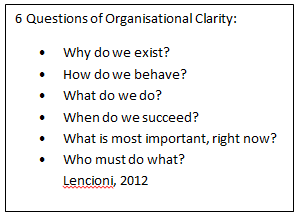
·         Ask the 6 questions of organisational Clarity


Once a shared understanding of why the things that are important are important, successful design and implementation becomes the foundation of school strategic direction and gives life to the annual operational goals staff identify. Visible success determined by how well the team engages in a cycle of action learning.


Brendan’s messages are simple, though not to easy to put into practice and he is highly engaging. I thoroughly enjoyed being part of the learning over the two days as did everyone who attended. He made us think a lot. I have been made aware through feedback that this post could be 3 and maybe I'll work on unpacking the three big ideas I took away from the time with Brendan in more depth.

Throughout, Brendan reiterates:

“Be KIND!”

“Be true to your season. Stand in front of people with heart and offer things of worth. Work with humility, mindful of the wisdom of others.”

“Be honest!” If you say it – Mean it! If you mean it – prove it! If it’s important, how do we/others see it?

I end with some of the humorous images Brendan used to prove this point.

How we see and perceive ourselves and the messages we send need to be viewed from many levels.

How do your people see you?:


DO YOU HAVE AN OPEN DOOR POLICY...

But inside others see a raging bull?


DO YOU THINK YOU’RE HUMBLE … YET ..

others feel they need to tell you how incredible you are with frequency.


DO YOU LOVE WORKING WITH PEOPLE .... BUT ...

they don’t feel they can ever find you


DO YOU SAY YOU SUPPORT THOSE WHO TAKE RISKS .... YET ...

the last person seen to take a risk round here ended up in your jaws....


brendan@spillaneconsulting.com.au
All images from istock-ww.istock.com


Food for thought.


Teaching for Intelligent Mindsets


Teaching for Intelligent Mindsets

A dissemination and resource bank of "Mindsets" gems!

SLIDESHOW

The above slide show was put together following this educators experience when Carol Dweck 'Chicken'ed to NZ. It has without a doubt been the highlight of the year and many amazing memories - life-changing and otherwise resonate from her visit. One big question I would like to explore further is "are we failing students?" Knowing what we now know about learning, brain development and best practice are we still readying students for the world lacking resilience and real life skills?

 Big messages from the symposium:
1. You never see an unmotivated baby!
2. Want turns students into non-learners? A non-learner mindset: If I do nothing I can't make a mistake.
3. Carol's research evidences how we give praise makes a big difference.
4. Praise: The struggle, the strategies and choices, learning from previous attempts, the problem solving, the improvement in learning.
5. Don't Praise: outcome - you're so smart you did that quickly and easily sends the message "unless I do well I'm not good enough".
6. A growth mindset builds resilience.
7. They haven't learned it YET! Watch Carol's TEDTalk
8. We have no idea what ANY of our students are capable of!!!!!!


@kiwiallana – http://t.co/wUlQg9T8rN


Embedded image permalink

Teachers are Learners

Whenever anyone asks me what I do, the reply has always been, with alacrity, “I'm a teacher!” Am I 'Teaching?' Not in the classroom, school sense, no. Mostly, I'm learning. And I love it. When it was suggested I blog about change I reacted as any 20th century learner – how do I do that? Can I do that? I enjoy reading other educators blogs – they are another powerful learning platform I’ve recently discovered. 

As I move forward I have to believe the universe is turning as it should, and I am doing all I can to make sure of the end goal. For me that is happiness, mine, my loved ones. When happiness is in question – change is afoot. Unless you’re prepared for perpetual unhappiness something must change. How big the change agent is, depends on the individual. My current ‘situational learning’ came about through change.

As a teacher Kath Murdoch’s teaching and reading underpinned my inquiry practice. FISH! A philosophy I embrace and share. Guy Claxton's 6 Pillars of Learning, Murray Gadd's writing research, the writing book, the habits of mind, modern/co-operative learning environments, Thinking tools, are all aspects of my teaching belief, what I value in teaching practice, how I still look atmyself as a teacher and a learner. Teaching and Learning, are synonymous with each other, I believe. I think if you are not open to ‘being the learner’ how can you engage in a learning environment of today? How can you possibly connect with the learners you’re charged with the care of? So, as an engaged learner, I am a better teacher for the learning I am privileged to be a part of.

So, who am I?
I'm Kate.
Right now I'm a learner!

Earlier this year I became 25% of Learning Network NZ (LNNZ), and my learning curve went viral. I have - learnt html, website design, graphic design (OK this is still early on in the peace - it's complicated!), become a Facebooker (no, I wasn't on FB before joining LNNZ), got a Twitter handle @learningnz (oh my gosh I love the learning to be had via this platform), jumped into POND, found that I'm not 10 feet tall and bullet proof, that everyone’s a critic and marketing might not be my forte, and I have been reminded how valuable a good team is and how much it can make a difference - astoundingly so.

Learning Network is the sum of 4! It is a working environment sometimes the antithesis of a school one. There are similarities: a culture exists, it’s perpetually constant and there is genuine passion for education and educators.

Teachers are self driven learners. Well I am, if I’m inspired. I always have a professional text on the bedside table (right now ‘Jab, Jab, Jab, Right Hook! – How to tell your story in a noisy social world’ by Gary Vaynerchuk. It’s a New York Times bestseller. I like the idea of telling a compelling story via social media) or a stack to get through on my desk. Now I'm surrounded by the best, most inspiring resources available. LNNZ provides education resources. For this to be great we have Dorne:
Dorne - wonder women of two roles: resources and accounts. If we don't have a resource you're looking for she'll tell you why or get it in for you. She'll give advice on what you're sourcing based on feedback and discourse. She's funny, imaginative and is my friend through the glass, referred to as the fishbowl due to our sustainably designed office space. Her experience and knowledge as the second longest LNNZ team member has meant an easy transition for me into the team. Always there to help work things out – from SAP to embedding youtube clips onto website. What to do, how to do it, go-to girl! I hope she thinks I am a quick enough learner.

Sometimes the energy, urgency, quantity gets away on teachers. I can get excitable. A friend sent me this once:


I could only assume it referred to me. And suppose it’s true. Some days it’s nice to know there’s always someone who can be relied upon. Someone who is ‘grounding’. I value people I know who can do this. Who are perfects. We have:

Diana - nestled at the front desk, answers the phone, takes all enrolments and invoices, checks all my work (omg she's good at that), organises our calendar, ensures needs are met, entertains and makes the best coffee shy of the cafe bought kind. 


There's me, of course, Kate - the learner. Responsible for events. I have refered to myself as "teacher by trade, marketer by accident", instigator, creator, deliverer, communicator, researcher, of all things eventsy. As a learner I am privileged to have been present for some of the greatest learning on offer. From New Zealand - Nathan Mikaere-Wallis, Mark Osborne, Andrew Cowie, Murray Gadd, Sheena Cameron and Louise Dempsey to name a few. And from across the planet - James Nottingham, Tony Ryan, Guy Claxton, Kath Murdoch, next year, Carol Dweck! I mean, for me, this is a teacher’s heaven? I have even had dinner with them J ...The conversations...  

I always thought of myself as a risk taker. I know I can, I’m not sure how good I am at it. So far, successful. I enjoy being challenged and engaging in meaningful discourse. I enjoy the creativity of ideas morphing into something tangible and exciting.

In a very insufficient nut shell that is the Learning Network mindset: bringing inspiration to NZ educators. With that in mind the final team member is of course:

Faye - the face, the driver, the champion, the force. Almost here from inception Faye is the most inspiring, excitable, fun, fast-paced, loyal, and generous, determined to provide quality for NZ leaders and educators with the biggest heart I’ve ever come across. The depth of knowledge and experiences leaves me in awe.

In the 6 months I’ve been here, this is what I find:


We provide NZ teachers with the most inspiring professional learning we, as the sum of 4, can put together. That’s inspiring. What does success look like? That’s an incredible journey.

We Love connecting with educators, with presenters, me with my PLN (although I admit I am different than those immersed at the chalk-face), providers, sponsors, leaders and inspirers.

Our ethos: the wow factor - fun, inspirational professional learning that is enduring. If we don't have it – we’ll want it - call. Talk.

And so, working alongside a small team I hear messages such as;

·         ‘teaching from the front is stupid’
·         ‘technology is NOT an add-on’
·         ‘everyone needs loads of opportunities to fail. Teach how to fail with grace’
·         ‘education is ideology’
·         ‘Everyday we sacrifice, we must give ourselves time for renewal. What is your regular source of calm?’ Right now mine is space, where no-one wants anything J
·         ‘become someone who is an “unstucker!”’

Change is scary and easy to put off. But alternatives need looking at too. And not being happy doesn't seem much of an alternative to me.

I'm happy being here. I love our ethos and what we strive for. It's tough and it's busy, but it's inspirational and it’s rewarding.

I’m learning, I’ve rediscovered FISH!, 


the team supporting me provides commitment and resilience and that makes me better at what I am – and what I am is – “a teacher”.

An 'aha' moment

Listening to Perry Rush giving a keynote at our conference last Thursday, something struck me. It was his comment about the fact that our kids are sent to school. They have no choice but to go. From the age of 6 to 16, they have to attend, and it's against the law for them not to. He equated this to a term in prison (not saying that schools are like prison, just saying that there is no choice for the individual, they have to be at a certain place for a certain amount of time). This was a powerful statement and it truly brought home the fact there is a HUGE responsibility - for teachers, principals, administrators and anyone else involved in the education industry - to ensure that those 10 years of enforced schooling for our kids are 10 years well spent. How do we do this? It's a question the team here at Learning Network NZ is constantly asking. We're lucky enough to be in touch with some of the world's foremost thinkers, leaders and educationalists - and we are always working on ways to better connect you with the knowledge, expertise and inspiration you need to do a great job in supporting and challenging our nation's learners, every day.

Wise words to start the year


From ‘can’t do’ to ‘can do’
Advice for parents, by Andrew Fuller

Research has proven Henry Ford correct when he said, “whether you think you can or that you can’t, you are usually right”. Helping young people develop a positive growth oriented mindset where they can improve over time and overcome setbacks powerfully predicts success. This shifts them from “can’t do” to “can do”. Here are some ways that parents develop this attitude in children.

Have a policy of “we fall down 7 times 
but we get up 8”. We all have set backs. There are times when we all have to pick ourselves up, dust ourselves off and start again. Most of us are experts in this even if we’ve forgotten it because this is the way we learned to walk. Sucking at something the first few times you do it is the first step to getting good at it.

Use “I noticed” feedback. Parents can use “I noticed” feedback for positive and negative behaviours. The number of comments made to kids that begin with the phrase “I noticed”, shape behaviour powerfully. For example, “I noticed you like to draw”, “I noticed you are really trying hard to”, “I noticed you’re reading a good book”. Believe me, they will notice that you have noticed! Parents can use this to calmly draw attention to negative behaviours. For example, “I notice you are up when you are supposed to be asleep” or “I notice that you are feeling upset right now”. This gives kids a chance to explain their actions or comply with parents’ wishes.

Praise effort more than ability. 
Tell your kids that they are geniuses but they don’t know it yet. It’s good to know that your parents think you are wonderful. Then focus most of your comments on effort. For example, “You really worked hard at that well done!” “I noticed you really tried your best at that, I’m impressed” or “Wow, your practice seems to be really paying off”.

Mistakes are opportunities to learn. 
If a child thinks they didn’t do well at something because they lack intelligence, they give up. When they can see they are on a pathway of improvement they persist. Mistakes are an essential part of learning. The physicist Niels Bohr defines an expert as “a person who has made all the mistakes that can be made in a very narrow field.” Creating something new involves make a lot of mistakes. One example is the bestselling Dyson vacuum cleaner. The inventor made 5,127 prototypes of the vacuum before getting it right. “There were 5,126 failures. But I learned from each one. That's how I came up with a solution. So I don't mind failure”. Parents can help children to learn that when you make a mistake all it means is that you haven’t learned how to get it right yet.

Dealing with set backs. 
No one really enjoys making mistakes. If we don’t learn from our mistakes we are destined to repeat them. It is hard to keep your enthusiasm up when you’ve not been selected for a dance team or a drama part or a sports team or failed a test at school. Parents can help kids by helping them to analyse mistakes. Some questions used to review a setback are: Ok so you didn’t do as well as you would have liked. Let’s see if we can learn from this? What parts of it did you do well? What parts of it didn’t go as well as you hoped? How much work would be involved in getting better at those parts? Would you change the way you prepared for it next time? In what ways? I know you can do better at this if you want to. Do you want to try again? How can I help you with this? If they decide not to have another go say, “Ok but don’t let your decision trick you into believing you couldn’t get better if you tried.”

Turn losses into tournaments. You may have already done this as a kid. After losing at a game, you may have said, “Ok, best out of three is the champion”. If you didn’t win that tournament perhaps you may have said, “Ok, best out of five is ruler of the universe”. Teach your kids that there is no loss; there is always a chance to have another go.

There is no try! 
As the Jedi master puts it, do or do not, there is no try. Parents shouldn’t accept “try” either. When kids say they are going to try ask them, ”does that mean you are going to do it or not?”

Focus on the way we do things rather than 
the result. Successful sports teams play the game the same way regardless of the score in the game. Focusing on the result causes people to panic or freeze up. Parents’ comments can cause a shift in their child’s awareness. Instead of commenting on the result, find something you like and notice it. For example, “you sang the first few bars of that song beautifully, it’s coming together”. Avoid the temptation to then add suggestions of ways to improve.

Talk about your role models. Young people today seem to lack positive role models. The media seems determined to serve kids up role models of testosterone fueled bozos or ditzy socialite women. The idea that you can partly shape your life on someone who you admire is alien to them. Talk about the people you admired as a kid. Explain why they have been important. Talk about the everyday heroes who have inspired you.

How to avoid a boring life. 
If you get scared of getting things wrong, you won’t try new things. If you don’t try new things you become bored and boring. Life becomes mundane, dull and routine. Parents can arrange to do things with their kids that they have never done before. Quirky adventures don’t have to take a lot of time or money but they do take some thought and planning. Plan to have your child (and yourself) go somewhere they’ve never been before or do something they have never done before. Don’t settle for anything less than an interesting life.

Think of a time when it was hard. 
We’ve all done things that at first seemed impossible. We’ve all struggled at times in our lives. Share some of those stories with your kids so they know that you have shared the same doubts as they have. Talk about times when you could have given up but you didn’t.

How to talk with them about successes. 
Kids want their parents’ approval. The way you provide praise will shape their future efforts. Let them know you are proud of them. Try to include in your delight at their success a comment on the effort that went into their success. For example, “I am so proud of you for getting that A, I know how much work you put into that project.” “You were great today. All that practice has really paid off. I’m proud of you”. “Wow when you put your mind towards something you really work hard and get it. That’s great”

Be exuberant. 
If you become the proud parent, kids will tell you that you are embarrassing them. Don’t believe them. Maybe don’t do it in front of other people but when you get them in private, let them know that you love them and think they are fantastic. They may pretend to you that they hate it but they all secretly lap it up.

Be the antidote to the drip feed of despair. 
Your kids will become upset at setbacks, will label themselves as “no good” or stupid if they don’t get a good mark and compare themselves negatively to others. It is so tempting for parents to try to soothe kids out of this or even provide a salutary lesson, “well if you’d tried harder you would have done better”. Don’t do this! Be determined to stay focused on effort and improvement. “I’m sorry you didn’t do as well as you hoped and if you want to have another go, let’s work out a way of getting better at it”. At first changing your parenting language might feel a bit weird. Focusing on noticing, commenting on effort and emphasising the power of having a go are the most powerful ways parents can set kids up for success.


This came through to us (with a directive to share!) from clinical psychologist, Andrew Fuller. Andrew works with many schools and communities in Australia and internationally, specialising in the wellbeing of young people and their families. He is a Fellow of the Department of Psychiatry and the Department of Learning and Educational Development at the University of Melbourne, and the the author of many best-selling books, including Tricky Kids, Life: a guide and Beating bullies. More info at www.andrewfuller.com.au
Copyright Andrew Fuller